
ATENÇÃO: Esta página foi traduzida automaticamente pelo Google Translate. Isto pode ter consequências inesperadas no conteúdo apresentado e, portanto, não nos responsabilizamos pelo resultado dessa tradução automática.
ATTENTION: this page has been automatically translated by Google Translate. This can have unexpected consequences and, therefore, we do not take responsibility for the result of that automatic translation.
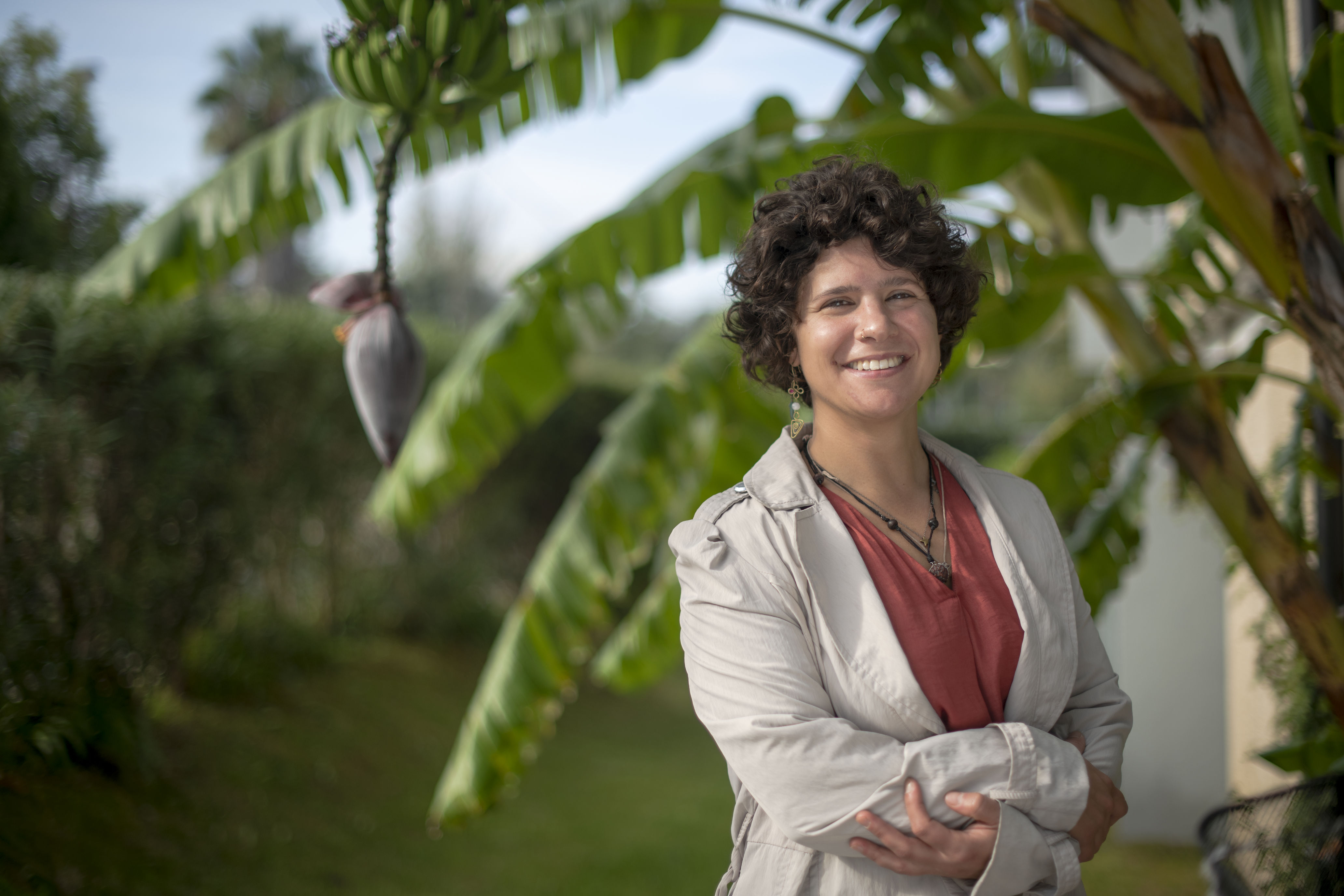
Researcher Dinâmia'CET-Iscte
PhD Student Urban Studies
What is the objective of this work observing and analyzing a cooperative in Montemor-o-Novo, Portugal, and another in the outskirts of Quito, Ecuador?
The objective of this research is to know and explore other ways of living in rural or peripheral, marginalized territories, seeking alternatives to the format generally applied through urban and territorial planning.
Currently, planning done by territorial management bodies is very much developed around urban centralities, whether it's peripheral areas or even rural areas. There is an urban-centered vision, some also call it developmentalist, that is, based on the idea that territories must be more developed, according to a specific model – which I designate in the thesis as "capitalist development model".
According to this model, currently we see in rural areas in Portugal a focus on monoculture, rural tourism and extractivism. This phenomenon also occurs in Ecuador, but it is not as recent.
However, peripheral areas are said to be poorly planned, have little housing, without schools, public services and other facilities. This type of development is creating quite dysfunctional, unbalanced and hierarchical territories, not only at the landscape level, but also of populations.
My proposal is to see what is being done to counter this trend. The two cases I analyze are social economy projects that try to be autonomous from the State and the market, departing from the logic of territorial development plans.
This research project aims to look at what other people do, what impact it has on the territory, how they inhabit it.
Ideally, it would be incredible to transform this into public policy proposals for different territorial development projects.
Can you present the two cases you follow?
Both are cooperatives, although the one in Portugal is an integral cooperative and the one in Ecuador is a savings and credit cooperative.
An integral cooperative is distinguished from uni-sectoral cooperatives that appeared long after April 25th and focused only on agriculture, or only on commercialization, or only on housing. An integral cooperative aims to satisfy all the economic needs of its members. For example, the Minga cooperative, which I am investigating, operates in commercialization, housing and construction, agriculture and services.
In this model, priority is given to providing autonomy to members so they can develop their own economic activities. This autonomy is given through the support infrastructure offered by the cooperative, from the invoicing and accounting system to a store where they can sell their products. There is a whole local support network and there was even a time when they made microcredits. There is also, in this support network, consulting in economics, design, etc.
The Minga cooperative was created in 2015 and today has about 150 cooperators, who daily enjoy the products and services offered through its structure, based on a solidarity economy and social and environmental responsibility.
Is the cooperative in Ecuador different?
It is a family savings and credit cooperative, which is very common in indigenous communities. The logic is for people to pool their savings and make internal credits. This cooperative is not formalized, but there is a legal regime for this type of cooperative in Ecuador. In this case, the cooperative is a family composed of about 90 people, from three generations. It started as a savings and credit cooperative and, at this moment, they grant credits between 10 thousand and 20 thousand dollars.
This granting of credit to the cooperative/family members is not a very bureaucratic process, has few conditions and is based on trust. They have also created health insurance, vehicle insurance and are thinking of implementing a retirement fund.
They also have the "common good fund", which draws inspiration from the logic popularized during the government of former President Rafael Correa (2007-2017): buen vivir – it is a stance very linked to the indigenous logic of cooperation, of living well with each other and with nature. This fund is to manage the surpluses, the profit they have from the interest on credits and money deposits, which is in a bank. The redistribution depends on people proposing a project for the common good of the family. The decision to use this fund requires that nine more people agree with the proposed project. There have already been projects for reforestation of land, distribution of baskets with products for the whole family, books, etc. There have also been emergency situations, in which this fund was activated.
What is the economic activity of each cooperator in the case of Ecuador?
The cooperators work outside the cooperative. They don't make money through the cooperative and they are not, nor do they intend to be, an open cooperative. They don't want it to grow or exceed the family. The cooperative is based on mutual support between members. However, outside the cooperative, members develop various activities individually, from carpentry, agricultural production, architecture, music, cultural management and participatory processes, environmental consulting, ceramics, education, etc.
How did the encounter with Ecuador happen?
It was random. I was doing my Master's and could do the internship in an architecture atelier anywhere in the world. In my research, I found the Alborde architecture atelier in Ecuador, in Quito, with which I identified a lot. I didn't know anything about Ecuador, but I thought what they did, at the level of architecture, was something very participatory: they built with the community, they were involved in some urban rehabilitation processes for more cultural issues, etc.
They accepted me, I went there for six months and there I also taught, for the first time, as an assistant. I really enjoyed it. I returned to Denmark, finished the thesis and went back to Ecuador – I was going to work for UNHCR (UN Refugee Agency) –, but I couldn't get the visa. So I went back to teaching at the University, in Quito, for a year and a half.
In the Master's in Urban Design, which she completed at Aalborg University, Denmark, Catarina Mateus carried out fieldwork focused on rural areas, on the path of Anthropology and very different from what is usual in Urban Studies.
She graduated in Architecture, at the Faculty of Architecture of the University of Lisbon, and the reversal of her research path towards urbanism occurred when she realized that many of the architects she admired "work for a real estate market, with unrealistic prices and conditions".
Catarina Mateus mentions that «she felt that urbanism in Portugal is very much based on laws, and is not imbued with social sensitivity and humility» which she understands to be necessary dimensions.
«In Portugal, there is more of a bird's eye view and expert view and the processes are not participatory as I understand they should be», she concludes.
How do you go from a society like the Danish one to another with characteristics, in principle, quite different in terms of organization and security, like Ecuador?
Ecuadorian society, I acknowledge, has changed a lot in recent years. In Latin America, I had only been to Brazil. When I arrived in Ecuador, in 2017, I felt that everything was quite safe and worked very well. The best universities were public, health services worked better than in Portugal, there were many things that surprised me positively, including the existence of a lot of environmental awareness – much more than here. Environmental awareness in Ecuador is very much originated from a culture of indigenous communities.
Meanwhile, there has also been a lot of corruption of these indigenous communities, since the extraction of oil and other materials is done within communities and their territories.
The first time I was there, I was quite impacted when visiting the Ecuadorian Amazon, entering one of the reserves and seeing huge billboards saying "oil brings education to my village" or "oil brings health to my village". You could see many tanker trucks transporting oil and even refineries in the middle of all that nature!
In the first years of Rafael Correa's government, there was great harmony with the indigenous logic. Ecuador was declared a plurinational State, the popular and family economy was integrated into the ministries, among other policies towards buen vivir.
Later this became a policy that some authors call neo-developmentalism: improving people's living conditions, but through resource extraction.
I'll give an example: it was necessary to take care of the Amazon and the Ecuadorian president launched a request for international support for this purpose. As no international institution financed this protection and recovery of natural resources, he decided that, to give people better living conditions in Ecuador, it would be necessary to exploit the Amazon. I was there between October 2023 and June of this year (2024) and noticed a difference. In a way, society became more violent... In recent years there has been a lot of political instability, also with the entry of the IMF, and this, in some way, facilitated the installation of drug trafficking networks that, together with natural disasters and poor public management, have generated a climate of social and economic instability. It has nothing to do with what I found the first time, in 2017.
What methods were used in your research work?
I did questionnaires, I did interviews, but it was through participant observation that I obtained the most data. The experience was very rich and I recorded almost everything in a field diary, which allowed me to create trusting relationships with people, and realize that they speak one way, but then, the action is sometimes different.
People's perception is often not the same as the academy's understanding or my understanding. Participant observation allows us to perceive incoherencies, for example, between personal aspects and those of the cooperative.
What results can we expect from this project?
I believe we will move towards creating more local, more autonomous, more self-managed, more cooperative and more self-sustainable management proposals. I don't yet know if in this research project I will have time to think about how this could be translated into concrete proposals for territorial planning, but I believe I will have interesting results for questions like "What logics, values and tools are alternative economies already creating for their members that can be scaled and multiplied?"
I hope this research can have an impact on public policies that are designed and implemented in rural areas, in order to promote more sustainable lifestyles.
The project is being developed at Dinâmia'CET-Iscte. How did this encounter happen?
I was granted a grant from FCT managed by Dinâmia'CET. It's even curious because I applied several times directly, but kept being rejected because my research is not simply architecture, it's not urbanism, it's not sociology, it's not economics... it's very transversal. Fortunately, this Research Unit at Iscte opened applications for four grants and I got one.
It is very important that research centers can receive projects through grants they have available. If that hadn't happened, I would have had to change the research a lot to fit it into a category. It is very important that there be decentralization in the allocation of grants, so that research centers can manage them, in order to allow transversality in projects and themes that do not fit strictly into standard categories.