
ATENÇÃO: Esta página foi traduzida automaticamente pelo Google Translate. Isto pode ter consequências inesperadas no conteúdo apresentado e, portanto, não nos responsabilizamos pelo resultado dessa tradução automática.
ATTENTION: this page has been automatically translated by Google Translate. This can have unexpected consequences and, therefore, we do not take responsibility for the result of that automatic translation.
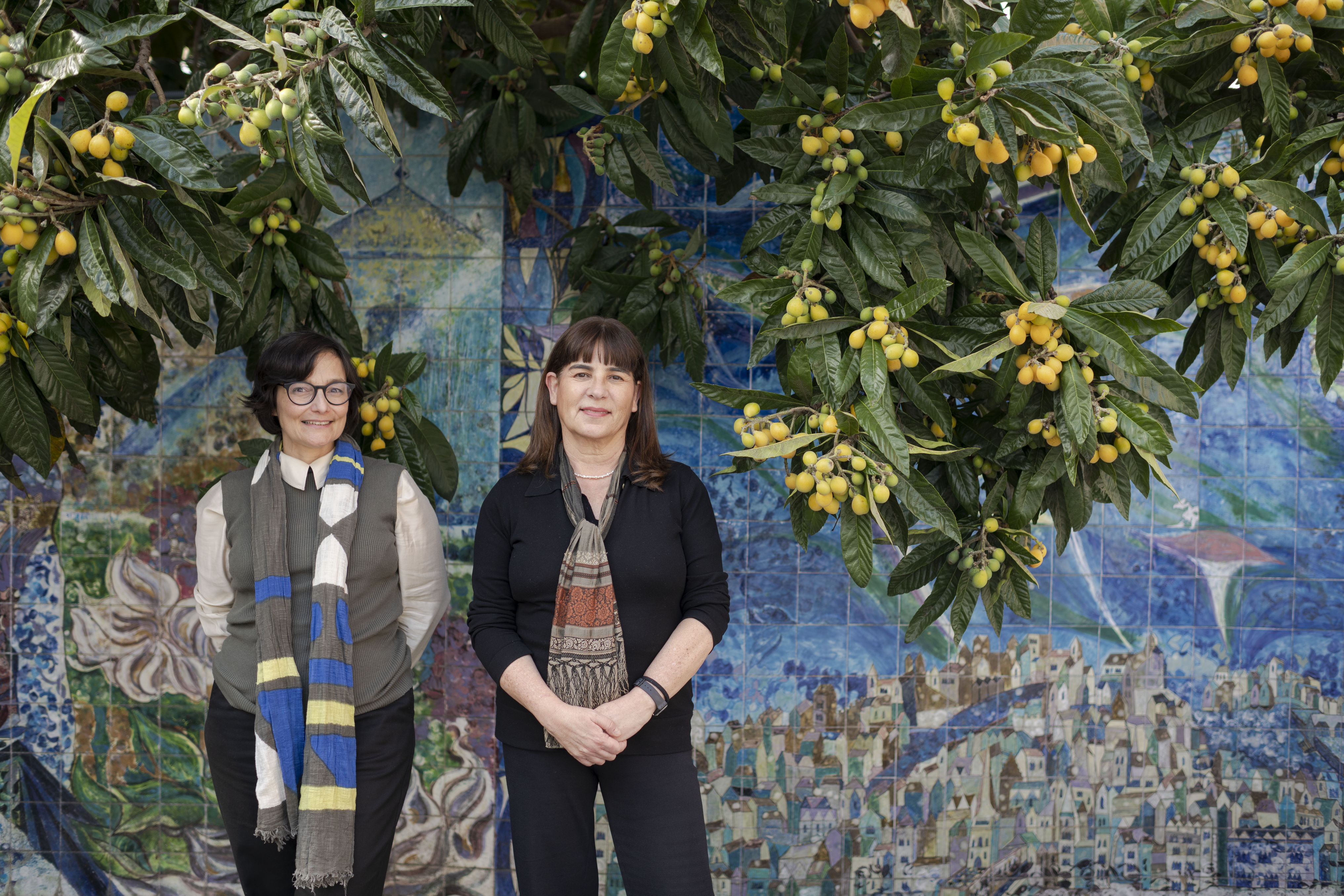
Researcher CIES-Iscte
Professor Iscte Technologies and Architecture
Researcher Dinâmia'CET-Iscte
What innovative solutions does the Climate Change, Cities, Communities and Equity in Health project propose?
Teresa Madeira da Silva (TMS) Combining urban health with urban design and raising student awareness about reducing the ecological footprint is one of the main concerns of Cli-CC.HE. How can we contribute to people's health through city planning? To foster debate around this question, we developed a wide range of activities and an event at Iscte with students from the Department of Architecture and Urbanism of the School of Technologies and Architecture.
Rita Cachado (RC) The project aimed to develop training focused on adapting to climate change, linking it with the issue of urban population health. Funded by the Erasmus+ program, this training was primarily directed at students in the field of urban planning, with the goal of qualifying intervention in spaces and territories, promoting cities and facilities adapted to current challenges.
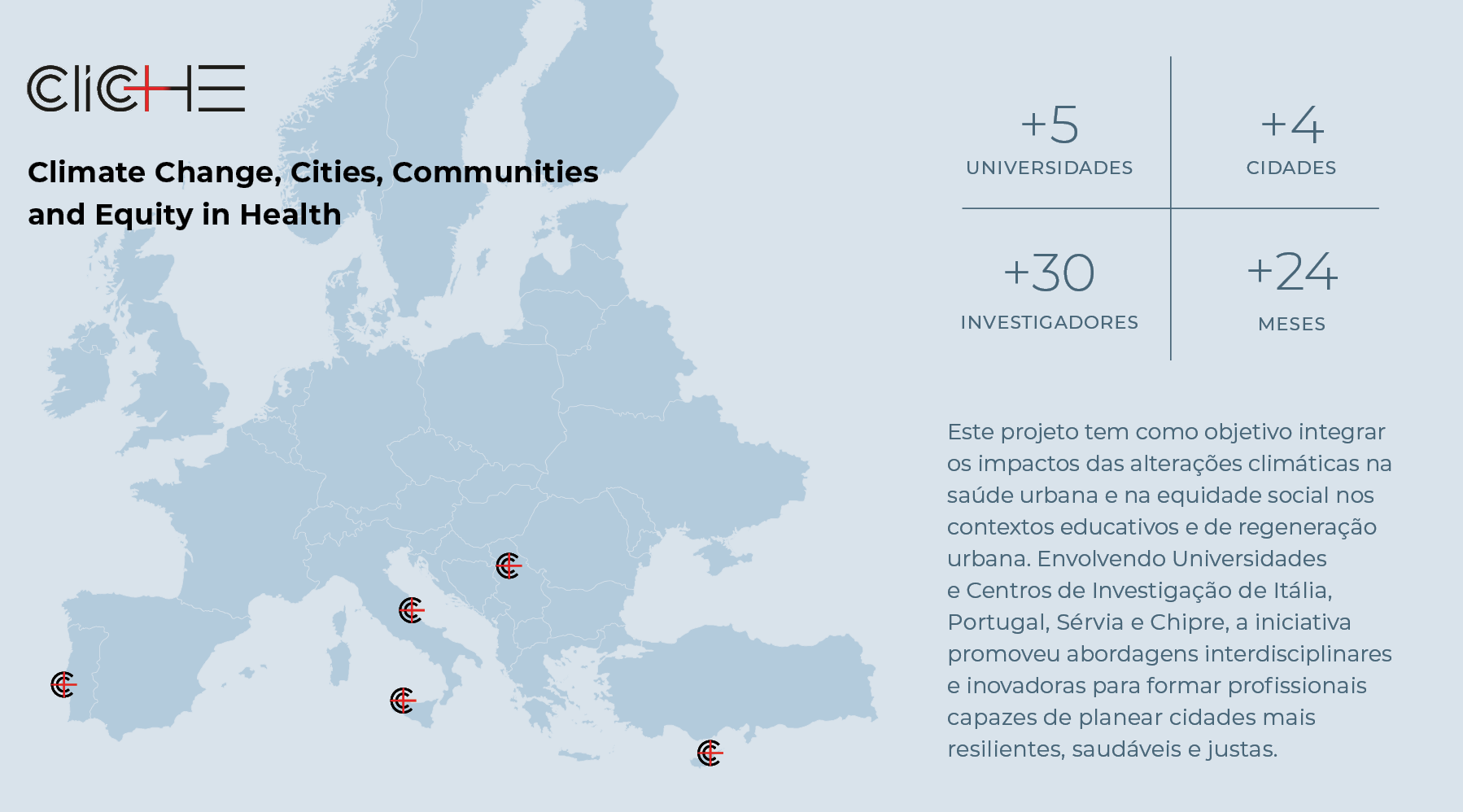
UNICAM – Università Camerino (Italy) was the main coordinator of the Cli-CC.HE project, involving, in addition to Iscte, the Cyprus Institute (CyI), the University of Belgrade (Serbia) and the Consiglio Nazionale delle Ricerche (Italy) focused on the health aspect.
The project focused on e-learning opportunities, with the results accessible to university professors who wish to develop, for example, a curricular unit, but also to anyone in the context of training activities.
How was the relationship between health and urban planning explored?
TMS We have several examples: on one hand, a street without trees reaches much higher temperatures than tree-lined streets; on the other hand, the presence of trees that cause allergies in spring can have negative consequences on residents' health. It's important to understand whether certain vegetation should be placed in certain areas of the city. Furthermore, the existence of squares, parks or gardens can have a positive contribution to public health, contrary to the noise from cars or planes, as seen in Lisbon. This is another example of the relationship between health and urban planning.
Does Architecture training already include this approach?
TMS In the Integrated Master's in Architecture classes at Iscte, we emphasize the connection between the urban and nature. We have already carried out work at Tapada das Necessidades and in the gardens of the Calouste Gulbenkian Foundation, which are good examples of this integration.
We try to show how buildings constructed in cities can dialogue positively with nature and provide better quality of life for the people who inhabit them. This idea aligns with the central objective of the Cli-CC.HE project: raising student awareness about the connection between health and urban design.
Has the dialogue between nature and construction been a concern of urban planning?
TMS In Lisbon we have good examples of this. The landscape architects who designed Praça de Espanha carried out exemplary work that included the construction of underground water retention tanks. As a result, the square no longer has flooding. Water is not to be thrown away!
Another example is the gardens of the Calouste Gulbenkian Foundation, an important case study: the underground parking lots manage to coexist harmoniously with the vegetation.
Several interventions in the riverside area carried out after Expo'98 also took climate issues into consideration, designing places for physical activities, shade, etc.
In Lisbon, there have been initiatives that articulate planning and climate change, such as the "A Square in Every Neighborhood" program, the pedestrian accessibility plan, the document "Municipal Strategy for Adaptation to Climate Change in Lisbon" (2017), or the Lisbon Climate Action Plan 2030 (written in 2021).
What were the areas of action of CIES-Iscte and Dinâmia'CET-Iscte in the Cli-CC.HE project?
RC We participated in the review of scientific articles on climate change in cities, health, among other areas. The systematization of this survey was in charge of the Cyprus team.
From this work, the issue of "heat islands" and the solutions that Architecture and Environmental Engineering are considering to mitigate the problem stood out.
In the development of the research methodology, seven areas were structured that correspond, in broad terms, to the objectives of a curricular unit. This was a task of the project's main coordinator, UNICAM, with the collaboration of the remaining partners. At each University, about twenty students participated in local workshops, with activities designed to understand how each objective and each unit of this methodological approach could be improved.
At Iscte, we held a workshop in which we focused on participatory qualitative methodology with the population. We also invited students to carry out urban art exercises as a way to disseminate the project. This work was coordinated by researchers Zoran Dukanovic, from Belgrade, and Ioanna Kyprianou, from Cyprus.
In the case of the city of Lisbon, we brought to the project the residents of the parish of Alvalade, a territory we intended to improve through urban planning combined with public health and integration with nature.
It was also planned that the partners would develop a set of tools aggregated in a toolkit, for which the collaboration of researcher Caterina Di Giovanni (Institute of Social Sciences – University of Lisbon) was very important. Twelve of these methodological tools were developed in e-learning and are now available on the site clicche.org/results in open access.
Who were the main stakeholders of the project? What was the relationship established with local authorities?
RC We started from scratch, so all the stakeholders were co-opted. We had no direct relationship with the Lisbon City Council. So, we contacted the Coruchéus Library, located in the São João de Brito neighborhood, in the parish of Alvalade.
We also spoke with the neighborhood's Residents' Association, which actively welcomed our activities. We had with us, from the beginning, AtelierMOB in the context of urban participation, and Zero Association, which functioned as an observer of the activities. Another partner was the National Civil Engineering Laboratory, through Marluci Menezes.
We managed to gather all these people in just three months, and it was they, together with the students, who implemented the qualitative methodology. This is a domain in which the other Universities did not have the same skills as us, at CIES-Iscte. For example, we master techniques such as developing interview guides, using field diaries and photographic documentation with people.
The project was distinguished by the events held. How did these initiatives contribute to achieving the objectives?
TMS The Forever Communities stands out as a multiplier event, held in Lisbon, which included students from the PhD in Architecture of Contemporary Metropolitan Territories and the Integrated Master's in Architecture (MIA), as well as professors and researchers from Iscte.
We had lectures at Iscte with professors and researchers: Pedro Pinho, researcher at the Faculty of Sciences of the University of Lisbon, and two Design professors from the Department of Architecture and Urbanism at Iscte, Professor Teresa Rodeia and Professor Paulo Goinhas.
We also had the participation of biologist Ivo Meco, who organized a guided walk between Iscte and the Coruchéus Library, in which students had the opportunity to observe and understand the relationship of vegetation with the urban and built environment. Ivo Meco explained the qualities of the trees we pass by every day, practically without noticing their characteristics and qualities. He also alerted us to the type of terrain where construction takes place and to the fact that sometimes the structures built do not dialogue with those that already exist. These activities were important to raise student awareness of the landscape component and the relationship between ecology and urban health.
The objective was to understand how infrastructures can be created that contribute to healthier urban environments.
We also promoted the sharing of results and experiences with international students from Italy, Cyprus and Serbia, who visited Iscte.
The team for this project involved various areas of knowledge, such as Anthropology, Architecture, Medicine, Urbanism and Environmental Engineering.
What project results do you highlight?
RC The most evident result is the online page that makes all resources available in open access. In terms of public dissemination, we mainly acted at Ciência Viva events.
The project also resulted in a specification document that gathers the data collected in the São João de Brito neighborhood by the students and which had the participation of Anthropologist Ana Catarino. The document was delivered to the Residents' Association.
The São João de Brito neighborhood has illegal origins and, therefore, it was a priority that the Lisbon City Council resolve issues related to infrastructure, water and sewage, which has already happened thanks to the project. Additionally, the Coruchéus Library already had a project to collect life stories, but had not been able to establish a connection with the residents. The Cli-CC.HE project made this connection possible, an advance that has great social importance.
In terms of societal impact, this was a project focused on people, mainly those being trained in urban planning and related areas, in order to understand how to act so that cities are healthier and more sustainable.